As educators, we are continually seeking to bridge abstract academic concepts and the tangible, complex world our students live in. In the Grade 5 Junior School classrooms, this connection was recently made through an immersive inquiry project that focused on Ookwemin Minising, a vital part of Toronto’s evolving waterfront.
At the heart of this inquiry lay the intersection of three powerful educational themes: authentic real-world learning, ethical citizenship and the Engineering Design Process. By anchoring the curriculum in a local, real-world problem like the Port Lands Flood Protection Project, we challenged students to see STEM (science, technology, engineering and mathematics) not just as a collection of subjects, but as a vital toolkit for ethical engagement and problem solving. Here, STEM serves as the discipline, engineering design as a process, and active, ethical place-based citizenship emerges as the outcome.
The Foundation: Master Making and Ethical Inquiry
The pedagogical roots of this project are grounded in the Massachusetts Institute of Technology (MIT) course on Master Making in the Classroom. This course emphasizes that deep, authentic learning often rises from the friction of failure and the iterative nature of design. We wanted to bring this “Master Making” mindset to our students by showing them that engineering is not a neutral act of assembly, it is a holistic process that recognizes that the needs of human beings are inseparable from the health of the ecological environment.
With this framework in mind, we launched the inquiry with an essential question that required both technical skill and empathy: How might we make a safe, strong and affordable structure that can withstand flooding and snow? Students were asked to consider the needs of others, actively contribute to the community and weigh diverse perspectives. They learned that a building is not just a shelter. It is a statement about how we care for one another in the face of environmental challenges.
Researching and Understanding the Problem
Before a single sketch was drawn, students immersed themselves in the context of the Portlands Flood Protection Project. They explored the significance of the name Ookwemin Minising (“the place where the black cherry trees grow”), which is a reflection of the area’s Indigenous history and natural environment, and learned about Indigenous worldviews, including care for the land.
Through a “Think-Pair-Share” protocol, students dissected the video “A New Waterfront City is Coming into View,” discussing the massive undertaking of the Port Lands project, including the redirection of the Don River to Lake Ontario. This sparked a series of “I notice” and “I wonder” statements, moving the class from passive observation to active questioning. Students asked:
“How did they remove the north plug?”
“How will you build on top of water?”
“Who might benefit from this project?”
These initial discussions were crucial in helping students articulate why the challenge mattered beyond the walls of the classroom.
Learning From Existing Designs
In order to look forward and create their own designs, students first looked back. They examined how humans across history and cultures have designed shelters to meet specific environmental needs. Alongside their research of the Indigenous roots of Ookwemin Minising, students explored traditional Indigenous housing including Inuit igluit, Anishinaabe wigwams and Haudenosaunee longhouses. They analyzed how specific structural designs, such as resilient dome shapes, were engineered to withstand powerful natural forces. By connecting these Indigenous building techniques to modern architectural structures, students grounded their future designs for Ookewmin Minising in a deep respect for the land and the enduring wisdom of Indigenous Peoples in Eastern Canada.
This comparative analysis also revealed a timeless truth: successful architecture is always a dialogue with the environment. Students drew powerful connections between traditional Indigenous practices, which used natural materials to withstand specific climates, and present-day engineering solutions. This phase reinforced the idea that innovation is often about adapting proven wisdom to new contexts.
The Engineering Design Process: Learning Through Failure
Moving forward, the research phase transitioned into the tactile reality of the Design Technology (DT) Lab under the guidance of Neekta Torabian, Junior School DT Tab Technician. Here, the “Master Making” philosophy of learning through failure became tangible. Working in pairs, students were tasked with a seemingly simple experiment: build a cube structure using wooden sticks and clay that can hold the most weight without collapsing.
The atmosphere in the lab was one of focused chaos and rapid iteration. Students made predictions, tested designs with incremental weights and recorded the results. As students witnessed the buckling and twisting forces at play, they applied their knowledge of forces, such as compression, identified the devastating effects of torsion and discovered the incredible strength of triangles and trusses. Students quickly learned that failure supported their discovery. A collapsed cube was not a mistake; it was a measurement. Reflecting on these results, students returned to their builds, reinforcing their cubes with beams and trusses, effectively applying the Engineering Design Process to iterate towards a stronger solution. Students cheered for their peers as their reiterative structures stood tall and proud.
Ideating and Generating Solutions
Fueled with new learning from the lab (and a whole lot of squished sticks and clay), students turned their attention to the context of Ookwemin Minising. Their next challenge was to design residential buildings suitable for the new island: townhouses, low-rise and high-rise buildings.
The design phase introduced a new layer of complexity: constraints. Authentic engineering never happens in a vacuum, so we introduced a strict budget. Students had to “purchase” materials like wood and roofing, forcing them to make difficult choices that mirrored the real-world crisis of housing affordability. They weighed the tradeoffs between affordable asphalt shingles (which might last 10 years) versus expensive metal roofs (offering greater longevity).
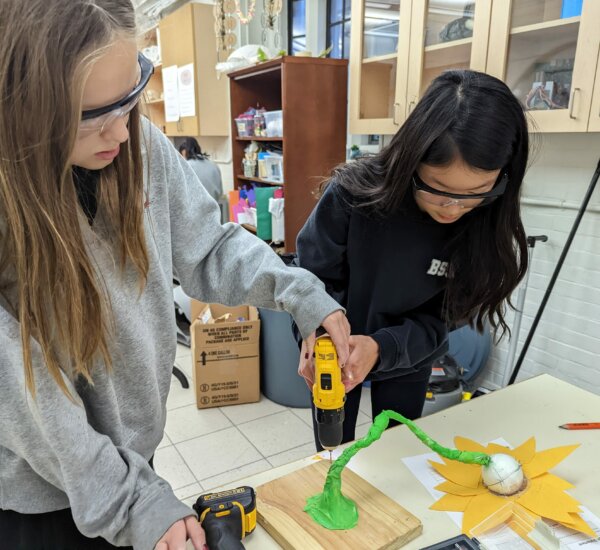
As they moved from sketches to physical prototypes, students developed practical skills handling hacksaws, hot glue and basswood with increasing confidence. Mathematical concepts of angles and scientific understandings of force were no longer abstract concepts. Instead, they were the difference between a roof that held and a roof that caved.
Knowledge Sharing: Experts and Peers
The big day finally arrived. The culmination of the project was a celebration of knowledge sharing that spanned generations and industries. Students proudly presented their physical prototypes to a distinguished panel of experts, including Leslie Woo, a Waterfront Toronto board member and CEO of CivicAction, Jennifer Kudlats, co-founder of a Toronto-based architectural firm, Michael J Cooper, a real estate developer and BSS parent, and Kayla Greenberg, Project Lead in the City of Toronto’s Environment and Climate Division.
The expert panel engaged thoughtfully with the students as peers, offering feedback on their designs’ structural stability and questioning their aesthetic choices. Leslie Woo pushed students to think deeper about liveability by considering environmental orientation, asking, “Did you think about where the door faces for the sunlight coming inside the house?” Jennifer Kudlats invited students to consider their interior layouts and the sensory experience of their builds. “Did you think about how many floors will be in your unit?” she asked, suggesting the use of shorter trusses to allow for more space on the sides of the structures. Jennifer also noted the thoughtful addition of skylights and discussed how architects choose materials for more than just durability. “We use materials not just because of the strength, but also for other senses like how they look or sound,” she explained, noting how a metal roof allows a resident to hear the raindrops while shingles might soften that sound. The feedback was rigorous, validating and deeply inspiring for the students.
The learning continued in the Grade 2 classrooms. While the Grade 2s had been exploring how air and water can be powerful elements, capable of destruction, the Grade 5 experts were able to demonstrate how deliberate design can mitigate those forces. Explaining their designs to a younger audience helped to consolidate the Grade 5s understanding, while simultaneously highlighting the continuity of the Ontario science curriculum.
Conclusion: A Living Project
Reflecting on the journey, it is clear that the Engineering Design Process provided a scaffold for meaningful, authentic learning. By integrating science, math and design, the Ookwemin Mining project allowed students to experience the interdisciplinary nature of these fields as they exist in real-world contexts and careers.
More importantly, it demonstrated that education is about more than acquiring knowledge. Education is about applying that knowledge to build a better world — literally! Through authentic inquiry and ethical design, our students learned that they have the agency to solve meaningful problems, ensuring that the communities of the future can be safe, inclusive and strong.
A strong foundation is, however, only the beginning. As the prototypes stand complete, capable of withstanding the forces of nature, a new challenge looms on the horizon. In the winter term, students will return to their designs with a new lens and apply their upcoming science unit on the conservation of energy, figuring out how to sustainably power their built communities. The question has shifted from “How does it stand?” to “How does it sustain?” How will the next generation energize their community while protecting our planet? We can’t wait to see what they design next!